PunchOut integration for your webshop? (OCI & cXML)
Your corporate client has asked you to set up a PunchOut integration with their procurement system. But chances are, you have never even heard of PunchOut integrations until now. No problem! Abeta is here to help you set up the right integration with your client's e-procurement software.
ABETA
Free demo
Curious how Abeta works for your business?
We'll show you how to set up OCI and cXML PunchOut integrations in just a few days — tailored to your ERP or webshop. No commitment required.
With a PunchOut integration, your business customer can log into your webshop directly from their own procurement system. The customer adds the desired products to the shopping cart, after which the contents are immediately sent back to their procurement software for internal approval. Abeta is the software in the background that creates this integration and ensures the connection runs smoothly.
This means no actual payment is made immediately, but the order is directly available in the customer's system. As a supplier, this makes the process easier for both yourself and your business customers.
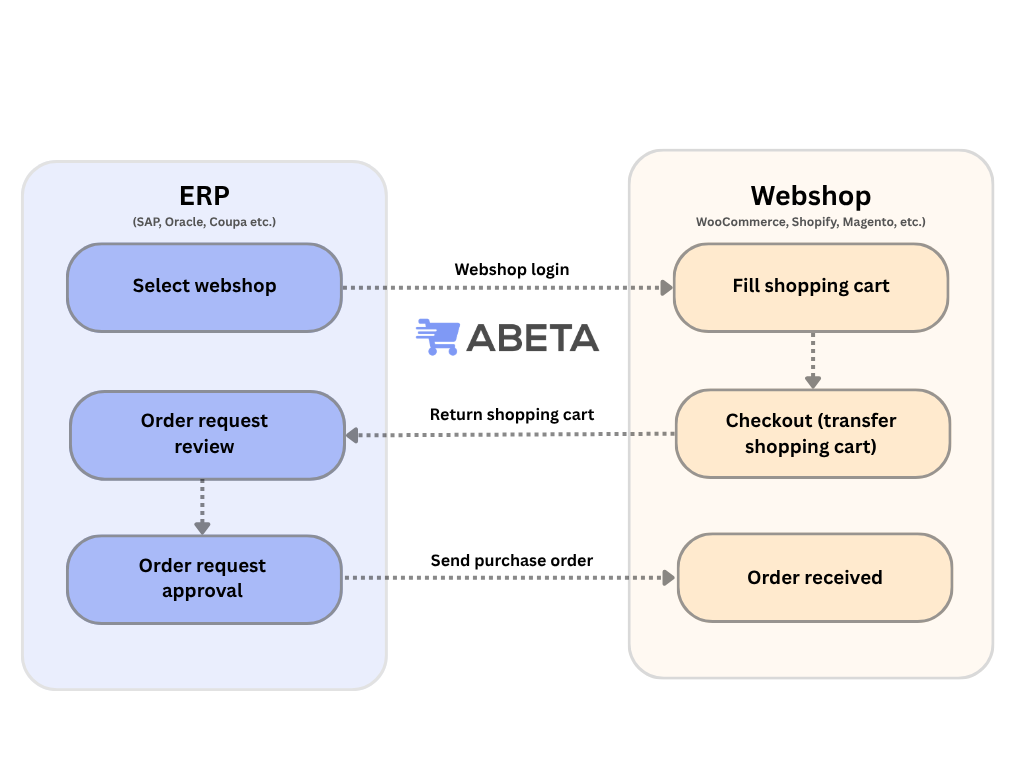
How Abeta automates B2B procurement: from the initial webshop login to the final purchase order inside the ERP.
No matter what your company's current technical setup looks like, we always have a solution to get your PunchOut integration live quickly. We offer three different PunchOut products:
Connect an existing webshop (Plugins): Do you work with a platform like WooCommerce, Shopware, or Magento? With our PunchOut plugins, we ensure your webshop communicates directly with your customer's system.
No webshop of your own? (Hosted Catalog): Don't have a webshop, but still want to offer your product range and customer-specific pricing digitally? The Hosted Catalog provides your customers with a clear, digital ordering environment.
Translation from OCI to cXML and vice versa (Converter): Does your webshop only support OCI, while your customer requires cXML? The Abeta Converter translates all messages live back and forth without requiring any changes to your webshop.
When you run your PunchOut integration through Abeta, we natively support both OCI and cXML. Thanks to our software, you can connect your webshop to any procurement system through a single central connection. Whether your customer uses SAP, Coupa, or Oracle, we can connect to any system - including custom-built software. Check out all our supported procurement systems.
Procurement professionals from clients who do not order via PunchOut can often choose which suppliers they place an order with. In practice, this means that one employee will order from 'Webshop A', while another prefers 'Webshop B'.
If a PunchOut integration is used, only a limited number of webshops are displayed inside their ERP. As a result, a customer will place orders with the same webshop much more often. Moreover, invoicing becomes a lot easier later on because the order was already approved upfront.
With a PunchOut integration, companies can allow their employees to log into a supplier's webshop directly from their ERP or procurement software. The ERP system sends along the necessary data to automatically and securely log the employee into the environment. Once logged in, the employee can fill their shopping cart in the webshop just like any regular user. As soon as this process is finished, the contents of the cart are not paid for immediately, but are sent back to the procurement software. (This means no actual order has been placed yet!)
Inside the procurement system, the necessary internal approval first takes place. As soon as all approvals are granted, the ERP system automatically sends a purchase order to the supplier, who can then proceed with delivery. If the supplier sends digital invoices, the ERP system can often automatically match them with the original purchase order. The Abeta integration fully automates communication between your ERP and the webshop.
In practice, there are two different versions of PunchOut. The user experience is very similar for both protocols, but the technical implementation, on the other hand, differs quite a bit. “PunchOut” is the overarching term that covers both versions.
OCI PunchOut: This standard was developed by SAP and uses standard HTTP POST and GET functions to log the customer in and send the shopping cart contents back. Are you a developer or technical consultant looking for the exact parameters, URL fields, and HTML code examples for your integration? View our technical documentation of OCI PunchOut directly.
cXML PunchOut: This standard was developed by Ariba and sends cXML (commercial XML) files back and forth to the ERP system to log the customer in, transfer the shopping cart, and modify orders. Check out our technical documentation of cXML PunchOut.
Depending on the system your client uses, you will need either OCI or cXML. The implementation that is most suitable for you depends, among other things, on the wishes of your client and the procurement software they use. Generally speaking, an OCI PunchOut implementation is slightly easier to set up than a cXML PunchOut connection.
If you run your connection through Abeta, both protocols are supported, and you can connect with virtually all procurement systems via one general connection with the Abeta middleware.
Most suppliers only come into contact with PunchOut integrations after a client explicitly asks for it. It is also becoming increasingly common for tenders and RFPs to explicitly ask for PunchOut capabilities with the existing ERP software.
To understand why corporate clients place such a high priority on this, we need to look at their internal procurement policies. By using e-procurement software, an organization proactively ensures (meaning before an order is placed) that internal buying rules are followed. This gives on-site employees the freedom to order independently, while the organization keeps central control.
Consider a school, for example: the janitor only has permission within the system to order from the cleaning supplies vendor, while teachers are allowed to order from educational resource suppliers. The local employee creates the purchase request themselves, after which the software automatically looks for the right approval within the organization. Only after this approval is given, the final purchase order is sent to you as the supplier.
To create a purchase request, your product data needs to get into your client’s e-procurement system. Manually copying data creates a heavy administrative burden and internal catalogs are often far from user-friendly. PunchOut solves both issues with three major advantages:
Speed: Products are transferred instantly. This saves time for the buyer and reduces the risk of errors. Additionally, invoicing afterwards becomes much simpler because the order has already been pre-approved.
User-friendliness: Buyers are used to modern webshops. Put simply, they much prefer working in your familiar e-commerce environment over a static internal ERP catalog.
Real-time reliability: Changing a price, adding a product, or running out of stock? Customers see this live in your shop right away, meaning your catalog is always up to date.